Forget Lava Lamps — Cloudflare's Edge Cloud Changed Everything
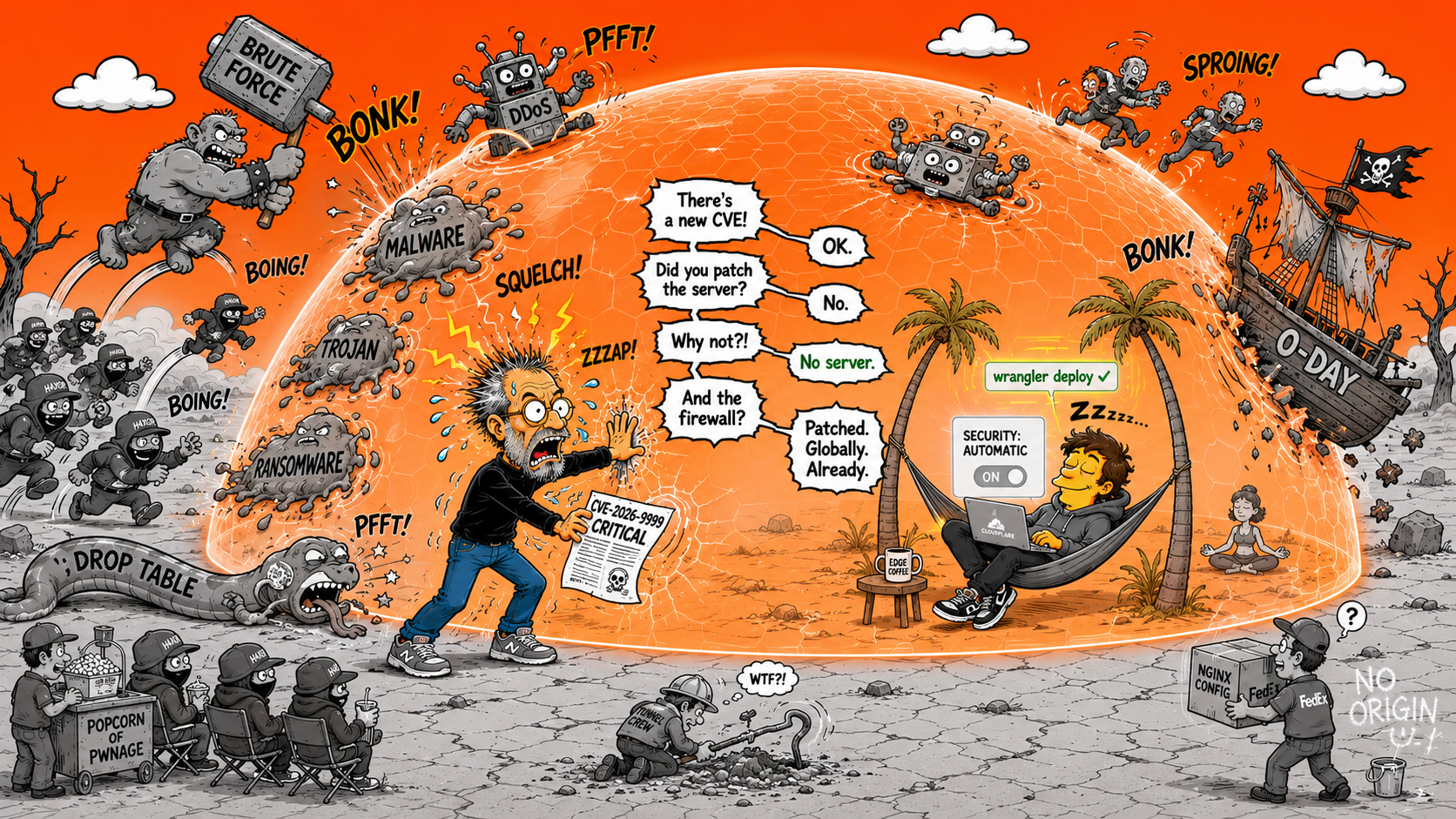
The Lava Lamps Are a Great Story.
But the Real Revolution Already Happened.
Cloudflare's famous wall of lava lamps makes for a great YouTube video. But it's a relic of a different era. The real paradigm shift is the edge cloud — where security isn't a thing you configure, it's a thing you get.
You've probably seen the video — 100 lava lamps bubbling away in Cloudflare's San Francisco lobby, feeding entropy into cryptographic systems. It's fascinating. It's clever. And it represents yesterday's thinking.
Not because the lava lamps don't work — they do. But because the entire cloud infrastructure model has shifted so fundamentally that the problems those lava lamps were solving are now abstracted away entirely. You don't need to think about them anymore. That's the real story.
The Paradigm Shift: From "Configure Everything" to "It Just Works"
In the old cloud computing model — AWS CloudFront, traditional CDNs, self-managed origins — security was a checklist of manual configurations. You had to set up SSL certificates, configure WAF rules, manage DDoS protection, handle rate limiting, set CORS headers, rotate API keys, patch servers, and pray you didn't miss anything.
Cloudflare's edge cloud flipped this entirely. Security isn't a layer you bolt on — it's the default state of the infrastructure.
Look at the difference. On the left, you have six layers of manual configuration between the user and the database. On the right? The edge handles everything — SSL, WAF, DDoS mitigation, bot detection, rate limiting — by default, out of the box, with zero configuration.
What a Request Looks Like in 2026
When a user hits your Cloudflare-powered app, this is what happens — all automatically:
No origin server to harden. No ports to close. No certificates to renew. No WAF rules to write. The entire security surface is managed by Cloudflare's infrastructure. Your code just runs — and it's secure by default.
Security: Automatic vs. Manual
Here's what the old model required you to do manually — and what Cloudflare now handles automatically:
Count them: seven security layers, all automatic, all free or included. With CloudFront or a traditional setup, every single one of these required manual configuration, third-party tools, or expensive add-ons.
Why This Is a No-Brainer in 2026
330+ edge locations. V8 isolates with sub-millisecond cold starts. Your code runs within 50ms of every user on Earth. No containers, no Lambda cold starts, no regional bottlenecks.
Workers free tier: 100K requests/day. D1 free tier: 5GB storage, 5M reads/day. R2: zero egress fees. You can run a production app for $0/month. Try doing that on AWS.
Deploy with one command: wrangler deploy. No Dockerfiles, no Terraform, no Kubernetes. SSL, WAF, DDoS — all on by default. Zero DevOps overhead for most apps.
Cloudflare handles ~20% of all web traffic. 100% uptime SLA on enterprise. Close to 100% reliability for everyone. The network has been battle-tested at a scale no one else matches.
Cloudflare Edge vs. Old Cloud (CloudFront, etc.)
| Feature | Cloudflare Edge | AWS CloudFront + Lambda |
|---|---|---|
| SSL/TLS | Auto, free | Manual via ACM |
| DDoS Protection | Always-on, unmetered | AWS Shield ($3K/mo for advanced) |
| WAF | Managed rulesets, included | AWS WAF (extra cost, manual rules) |
| Bot Detection | ML-based, automatic | Not included |
| Cold Starts | <1ms (V8 isolates) | 200ms–1,500ms (containers) |
| Edge Locations | 330+ | 600+ (but compute in ~30 regions) |
| Egress Fees | $0 (R2, Workers) | $0.085/GB+ |
| Database at Edge | D1 (SQLite), KV, Durable Objects | No — connect to regional RDS/DynamoDB |
| Deploy Complexity | wrangler deploy | CloudFormation / Terraform / CDK |
| Origin Server Required | No | Yes (EC2, ECS, etc.) |
| Free Tier | 100K req/day, 5GB D1 | 1M Lambda req/mo (12 months) |
No Origin. No Exposure. No Problem.
Here's the most underappreciated thing about the edge model: there is no origin server. When you build on Workers + D1, there's no EC2 instance with open ports. No Nginx to patch. No Docker container to update. No SSH access for attackers to target.
The entire attack surface collapses. Your "server" is Cloudflare's global network — a network that already handles roughly 20% of all HTTP requests on the internet. It's been hardened against every attack vector imaginable, at a scale no individual team could ever replicate.
The key insight
The lava lamps video is about Cloudflare solving hard security problems so you don't have to. The edge cloud is the same philosophy, taken to its logical conclusion — security fully abstracted into the infrastructure. You don't configure it. You don't think about it. You just deploy your code and it's secure by default.
Is It Perfect? Close Enough.
Nothing is 100% reliable. But Cloudflare's edge infrastructure is as close as it gets. They handle traffic for ~20% of all websites. Their network has survived some of the largest DDoS attacks in history. When Cloudflare goes down, it makes the news — because it almost never happens.
For developers in 2026, this is a no-brainer:
- Easy —
wrangler deployand you're live. No infrastructure to manage. - Cheap — Generous free tier. Zero egress. No surprise bills.
- Fast — Sub-millisecond cold starts. 330+ PoPs. Global by default.
- Reliable — Battle-tested at internet scale. Close to 100% uptime.
- Secure — By default. Not by configuration.
The lava lamps are cool. But the real story is bigger: Cloudflare built an edge cloud where security is invisible — because it's everywhere, all the time, for everyone. That's the paradigm shift. And it already happened.
Related: How Cloudflare Uses Lava Lamps to Encrypt the Internet · Cloudflare Has Won Every Battle It Picked · Cloudflare vs Vercel